

How do you know when your baby is ready to start weaning?
Approaching weaning (aka starting solids) is often an exciting time for parents, and the first question on most caregivers’ lips is “when should I start weaning?”. Despite clear guidance in place, this is still a question that can lead to a huge amount of confusion and contradicting opinions, so here’s everything you need to know.
Starting solids – what the NHS recommends
The NHS recommends waiting until your baby is around 6 months old before introducing solid foods. This guidance aligns with the World Health Organisation and is based on evidence on how babies’ bodies and brains develop.
You may well have heard that starting solids earlier helps babies sleep better, is necessary for weight gain, or even manages conditions like reflux, but the reality is that these beliefs are not backed by robust evidence. There can, however, be scenarios where a health professional advises parents to commence weaning their baby prior to 6 months, for example, if a child is considered at high risk of developing food allergies, but this advice should be provided on an individualised basis by a registered healthcare professional who has assessed that child.
Breast milk or formula milk is sufficient to meet your growing baby’s nutritional needs until around 6 months of age.
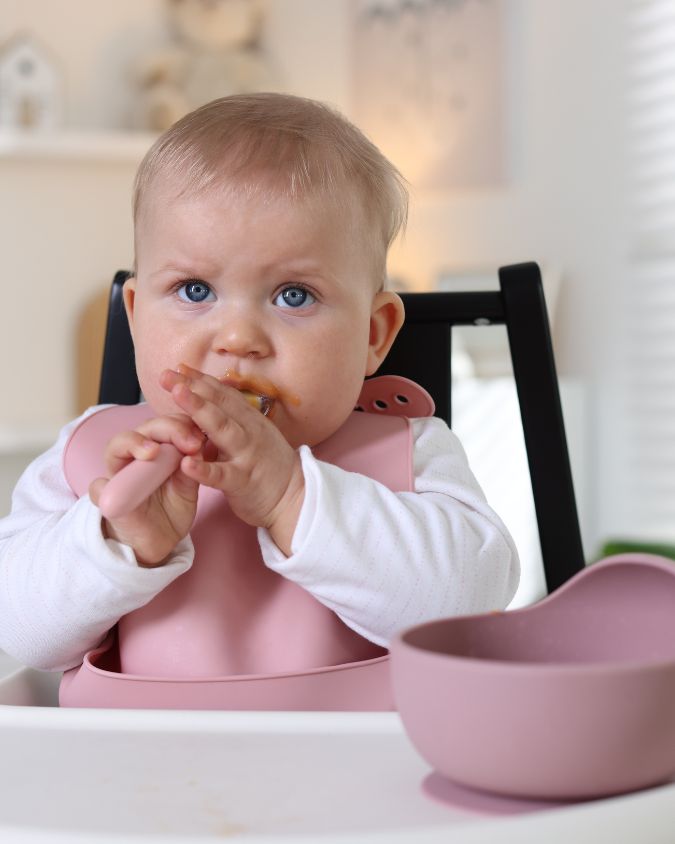
Signs your baby is ready to start weaning
Whilst guidance states that babies are ready for weaning around 6 months of age, parents are encouraged not to focus solely on the calendar and instead to pay attention to three key developmental milestones that indicate a baby is ready to start weaning. All three developmental milestones should be present, indicating that your baby is ready to start solids.
- They can sit upright with minimal support and hold their head steady
Weaning is a complex motor (body) task, and your baby needs to be able to sit in a supported seating position and keep their head upright and stable. They may not sit independently for very long, and a suitable highchair will support positioning, but they should be able to maintain an upright posture and hold their head up independently. This is essential for swallowing safety and preventing fatigue once starting solids.
- They can coordinate their eyes, hands, and mouth
To support feeding from the start of solids, your baby should be able to pick something up and bring it to their mouth with reasonable accuracy. This hand-eye-mouth coordination is an important marker of brain development and motor skills, and will allow your baby to explore food in a meaningful way.
- Their tongue-thrust reflex is diminishing (or lost)
Babies are born with a protective reflex that pushes foreign objects out of their mouths, but this does not mean that if you try to introduce solids to your baby too early, the food may get pushed back out. As this reflex diminishes, your baby will start moving food from the front to the back of their mouth and start learning to eat, so it’s an important indicator that the time is right to start weaning.
When should babies born prematurely start weaning?
If your baby was premature, it’s natural to wonder if there are different rules about starting solids. For premature babies, their corrected age (calculated from their due date, rather than their birth date) is usually the most helpful reference point, and BLISS the leading UK charity for babies born prematurely state that most premature babies are usually ready to start solids at around 6 months corrected age, no earlier than 5 months corrected and ideally no later than 7 months corrected (otherwise seek support). Much like babies born at term, parents of babies born prematurely should look out for the key signs that their baby is developmentally ready for solids, as shared above.
If you’re ever unsure about when to start weaning, your baby was premature or has any health conditions, your health visitor or GP is the best first port of call. They can help you assess readiness and other factors with your baby’s specific history in mind.

Common myths about when to start weaning
There is no shortage of weaning advice out there, from well-meaning relatives, online forums, books and more. Often, recommendations or suggestions about weaning in these sources are actually myths. Here are four of the most common myths worth knowing about.
“My baby is waking more at night – they must need to start solids”
Night waking is one of the most common reasons parents consider starting weaning early. It’s an understandable consideration, as night waking is often assumed to be associated with hunger, and there is often a perception that introducing solids earlier improves sleep. Babies wake for all sorts of reasons, and there is no evidence that starting solids earlier than recommended improves sleep.
“They are watching you eat; they must be ready to start weaning”
From four months onwards, babies become increasingly curious about what the people around them are doing, whether that’s your dinner, your phone, or the dog. Showing interest in food is, of course, encouraging, but it’s not a specific sign of weaning readiness. Look for the three developmental milestones above as a priority.
“Milk isn’t enough – they seem hungry”
Breast milk and formula are designed to meet your baby’s nutritional needs for the first six months of life, and for the vast majority of babies, milk remains the primary source of nutrition well into the weaning journey, with solid foods complementing it, rather than replacing it.
If you’ve read this and think your baby is ready to start solids, good luck as you start the steps into the wonderful world of food. If you have any concerns, about development, allergies, or whether your baby is getting enough nutrition from milk alone, your GP or health visitor is a brilliant first port of call.
Read more – 10 gut friendly foods when you start weaning
By Lucy Upton
Lucy Upton is a registered Paediatric Dietitian specialising in early years nutrition, with a particular focus on infant feeding and weaning.
With extensive clinical experience supporting families, Lucy is passionate about providing evidence-based, practical guidance that helps parents feel confident during their baby’s feeding journey.
She regularly contributes expert advice across digital platforms and collaborates with trusted brands, including BioGaia, to help translate nutrition science into clear, accessible support for everyday family life.